
Understanding Improvement Driven Non Adherence
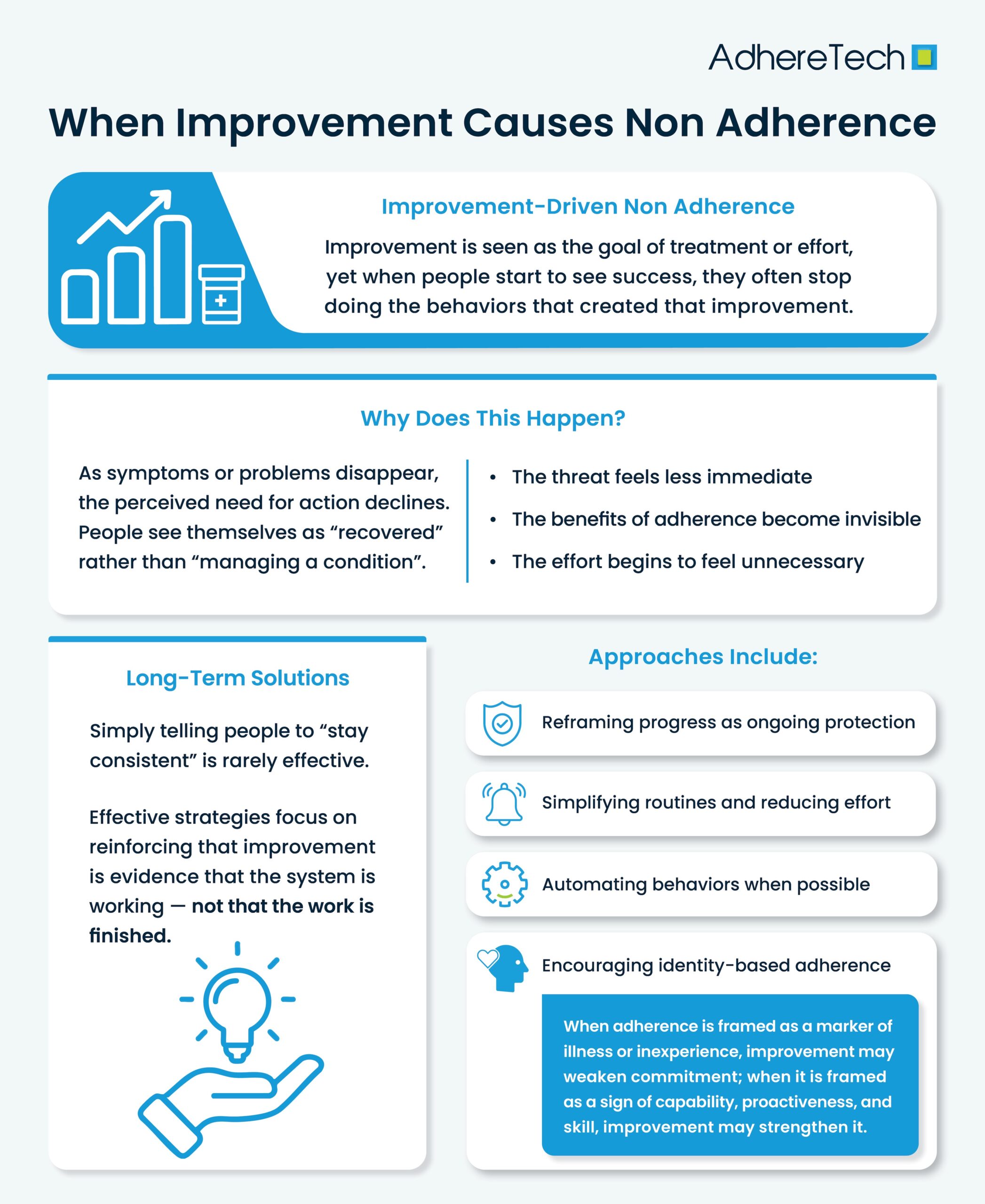
Improvement is supposed to be the reward. In medicine, education, technology, and personal change, progress is framed as the moment when effort finally pays off. Symptoms ease, systems become simpler, and outcomes improve. Yet across many fields, a quiet paradox appears again and again. As things get better, people often stop doing the very behaviors that made improvement possible.1 This phenomenon, which can be called improvement driven non adherence, challenges some of our most basic assumptions about motivation and rational decision making.2
At first glance, non adherence is usually blamed on barriers. Cost, complexity, side effects, time pressure, or lack of knowledge are the standard explanations.3 Remove the barrier and adherence should rise. But improvement driven non adherence emerges precisely when barriers have been reduced.3 The patient feels better. The student understands the material. The user experiences fewer problems. In these moments, adherence drops not because the task is harder, but because success has changed how the task is perceived.3
Non Adherence in Healthcare After Symptom Improvement
One of the clearest examples comes from healthcare. A patient with high blood pressure begins medication and lifestyle changes. Over time, their readings normalize. Headaches fade. Energy improves. At this point, adherence often declines. The improvement itself sends a powerful message. The illness no longer feels present, the treatment begins to feel optional. What was once a protective behavior now feels like an unnecessary burden.
This is not simple forgetfulness or rebellion.1 It is a shift in mental models. When symptoms disappear, people unconsciously revise their understanding of risk. They move from thinking “I am managing a condition” to thinking “I am fine.” The absence of immediate negative feedback makes the benefit of adherence invisible, while the costs remain tangible. Time, inconvenience, and side effects feel less justified when the threat is abstract or distant.1
Psychology of Adherence and Perceived Risk
Psychology helps explain why improvement undermines adherence. Humans are wired to respond more strongly to immediate experiences than to future probabilities.4 This present bias means that when pain or danger is gone, motivation collapses.4 Improvement also triggers a sense of regained control. People feel they have proven their competence and may believe they can relax their efforts without consequence.4
In some cases, improvement threatens identity. Continuing strict adherence can feel like admitting ongoing vulnerability, while easing off allows a return to a preferred self image of health or independence.5 The desire to see oneself as “recovered” or “normal” can be stronger than the desire to remain protected.
Education and Learning Plateaus After Early Success
The same pattern appears outside of medicine. In education, students who see early success in a course often reduce study time.6 Initial mastery creates confidence, but also complacency. When material becomes more complex later, performance suddenly drops, and the student is surprised.6
Here, improvement distorts feedback. Early success suggests that effort is no longer necessary. The student misinterprets progress as permanence rather than as a temporary outcome supported by ongoing work. Improvement masks the need for continued discipline.6
Technology Reliability and Risky User Behavior
Technology design offers another example. Security systems, backup routines, and safety protocols are followed most diligently right after a failure. As systems become more reliable, users bypass safeguards. The absence of problems creates the illusion that protections are no longer necessary.7
Ironically, the better a system works, the more vulnerable it may become. Improvement reduces vigilance. Reliability invites risk taking. Over time, the system drifts toward fragility not because it failed, but because it succeeded too quietly.6
Personal Habit Change and Behavioral Regression
Even in personal change, such as fitness or financial habits, improvement often causes regression.8 Early weight loss leads to relaxed eating rules. The person feels they have earned flexibility. Over time, the original gains erode, and the cycle repeats.
This pattern is especially frustrating because it feels self-inflicted.6 Yet it follows the same logic seen elsewhere. Improvement changes how effort is evaluated. What once felt essential now feels optional, even indulgent.
Why Traditional Adherence Strategies Fail
Understanding improvement driven non adherence matters because traditional solutions often fail.9 Education alone is rarely sufficient. Telling people that adherence is still important after improvement sounds logical, but logic competes poorly with lived experience. Similarly, increasing reminders or warnings can feel patronizing when the individual feels well or successful.9
The core issue is not lack of information. It is a mismatch between perceived risk and actual risk. When people feel safe, they behave as if they are safe, even when the protection depends on continued action.8,9
Designing Systems That Support Long Term Adherence
More effective approaches focus on reframing improvement itself. Instead of treating improvement as a finish line, it must be presented as evidence that adherence is working.9 Saying “you are better” subtly implies completion. Saying “this improvement shows the plan is protecting you” reinforces continuity.
Design also plays a role – using systems that reduce the salience of effort help maintain adherence during periods of improvement. Simplified routines, automation, and default behaviors lower the cost of continuation when motivation dips. In healthcare, this can mean longer prescriptions or integrated follow up.10 In education, it may be structured practice schedules that persist even when confidence rises.
Identity Based Approaches to Sustained Adherence
Another powerful strategy is to normalize fluctuation. Stable periods are exactly when maintenance matters most, and teaching this reframes calm as a responsibility rather than a signal to disengage.10
Finally, addressing identity is crucial. When adherence is framed as something only sick, struggling, or inexperienced people do, improvement naturally pushes people away from it. When adherence is framed as a trait of capable, proactive individuals, improvement can strengthen commitment rather than weaken it.10
Conclusion: Sustaining Success Beyond Improvement
Improvement causing non adherence is not a flaw in character. It is a predictable human response to success. By recognizing this pattern, we can design systems, messages, and supports that anticipate the drop in motivation that follows progress. True success is not just achieving improvement, but sustaining the behaviors that made improvement possible long after the urgency has faded.