
Caregiver Definition : A person who provides physical or psychological care to someone else who is unable to support themselves fully independently due to declining health, illness, or underlying condition.1
- Caregivers commonly support loved ones with … dementia, cancer, chronic illnesses, mental health conditions, and neurological conditions.1
- In the United States, the unpaid labor costs associated with serving as caregiving equate to over $600 billion annually.2
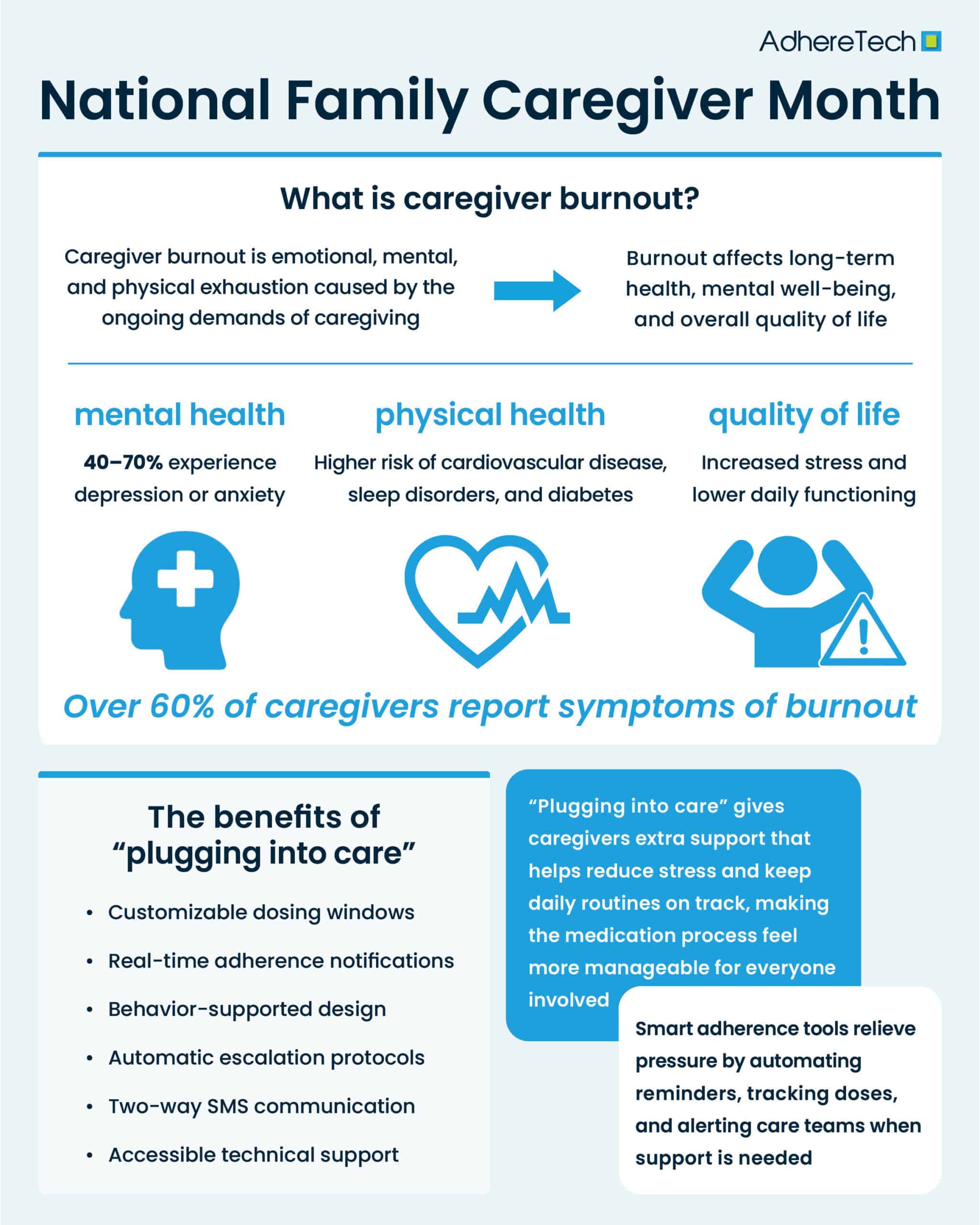
Caregiver Burnout Definition: State of physical, emotional and mental exhaustion that can occur due to dedication of time and energy invested in managing the health and safety of someone else.1
- Over 60% of caregivers report symptoms of burnout.1
- Symptoms include …
- Emotional and physical exhaustion
- Withdrawal from friends, family, and loved ones
- Loss of interest in activities previously enjoyed
- Feeling hopeless and helpless
- Changes in appetite and/or weight
- Changes in sleep
- Inability to concentrate
- Weakened immune system
- Long-Term Consequences include…
The Role of Caregivers in Medication Adherence
Caregivers are cited as vital in supporting their loved ones with medication management. Their responsibilities often include organizing medication schedules, administering medications, monitoring for potential side effects, keeping detailed records of medication(s), and communicating with healthcare professionals.7
Dementia x Medication Adherence
Dementia: Dementia is a chronic and progressive syndrome in which there is a deterioration of cognitive functions, including short and long-term memory loss and behavioral disturbances, beyond what is expected along normal aging.8 While general estimates suggest 20%-50% of patients do not take their medication as prescribed, non-adherence rates in elderly living with dementia can range from 17%-100%.8
- Caregivers of patients living with dementia express a sense of obligation to take responsibility for their loved one’s medication administration.9
- A web-based survey found that among caregivers …
Cancer x Medication Adherence
Cancer: Cancer medication adherence is critical for ensuring the full efficacy of cancer medications.10 The complexity of treatment, drug-food intersections, drug-drug interactions, cost of treatment, and patient-related factors, such as forgetfulness, all increase the ability for patients to manage their medications and take them as prescribed by their providers.10
- Focus groups with caregivers for adults with acute myeloid leukemia (AML) revealed adherence challenges due to … difficulty understanding dosing directions, difficulty managing medication routine, number and size of pills, and side effects.11
- Oral Oncolytic Therapy (OOT) → Caregivers responsible for complex and varying dosing regimens (dosing adjustments, cycling, combined therapy, temporary or permanent interruptions to treatment).12
- Caregivers are faced with monitoring and decision-making in managing symptoms, side effects, OOT toxicities, and potential drug-drug or food-drug interactions.12
Schizophrenia x Medication Adherence
Schizophrenia: A serious mental health condition that affects how people feel, think and behave – often resulting in a mix of hallucinations, delusions, and disorganized thinking and behavior.13 Symptoms of schizophrenia can make it difficult for individuals to consistently take medication, as impaired insight, cognitive impairments and disorganized thinking often interfere with remembering medications and/or believing treatment is necessary.13
- Caregiver burden increases when caring for patients with suboptimal treatment adherence.14
- Additional burden results from increased risk of poor outcomes, hospitalization, or relapse due to nonadherence.14
- One study found that caregivers reported non-adherence rates of 54.5% among patients living with schizophrenia.15
- Poor adherence to antipsychotics was significantly associated with caregiver burden (p < 0.01) and experience of anxiety (p < 0.0001).15
AdhereTech: Plugging Caregivers into Smarter Support
In celebration of National Family Caregiver Month this November, this year’s theme is Plug-In To Care, emphasizing the power of connecting caregivers with tools and technologies to reduce caregiver burden, a vital strategy for protecting the well-being of caregivers and their loved ones.
Medication management is one of the most time-intensive and emotionally demanding aspects of caregiving. Between tracking complex regimens, managing refills, and attempting to address missed or refused doses, caregivers often bear the responsibility of ensuring their loved one’s treatment stay on track – oftentimes with limited support.3, 9, 11, 12
At AdhereTech, we’re proud to reduce the burden placed on caregivers. Our smart devices automatically capture real-time data on medication use, offer reminders, support refill coordination with specialty pharmacies, and communication between patients, care givers, and care teams. This technology allows caregivers to stay connected and informed without the burden of manual tracking – preserving patient autonomy and offering peace of mind to caregivers.
The Benefits of “Plugging into Care” with AdhereTech for Caregivers:
- Smart devices with customizable dosing windows, supporting complex dosing and titration schedules.
- Real-time SMS notifications that provide automatic insight into loved one’s adherence behaviors and/or missed doses.
- A customizable and supportive reminder system – gentle glow (one hour before dosing window), chime (every 15 minutes during dosing window), and SMS text or Phone Call (notification of missed dose and ability to provide reason for missing dosage).
- Rooted in the principles of behaviorism, AdhereTech minimizes patient and provider burden while subsequently supporting long-term habit formation.
- Automatic escalation protocols if nonadherence persists, ensuring timely intervention that prevents unnecessary complications or hospitalizations.
- Integrated platform, Aidia System, provides real-time insights into patients adherence behavior to providers and allows for analysis of long-term adherence data to facilitate better care coordination.
- SMS communication that enables patients to report reasons for missed doses in real-time.
- Patients can connect with AdhereTech’s technical team 7 days a week, allowing for rapid escalation of any potential concerns to specialty pharmacies, providers, and trial sites to ensure adequate, timely support.
- Reduced emotional strain on caregivers, knowing that loved one’s care teams are informed and connected.
- Allows for early intervention capabilities to prevent complications and hospitalizations, reducing additional, unnecessary stress on caregivers.
Caregivers are the backbone of healthcare, providing compassion, structure, and stability in moments when their loved ones need it most. Yet, the emotional, physical, and logistical demands of caregiving often go unseen and unsupported.1, 2, 3
As we recognize National Family Caregivers Month, the 2025 theme, Plug-In To Care, reminds us of the importance of connection – not only between caregivers and their loved ones, but also between caregivers and the tools that can help them and their loved ones thrive.1
At AdhereTech, we’re proud to be part of that connection. By combining smart technology with human-centered design, we aim to reduce caregiver burden, improve patient outcomes, and create systems of care that empower rather than exhaust. When caregivers are supported, patients benefit – and the entire healthcare system becomes stronger.
Together, let’s continue to honor, empower, and plug caregivers with the support networks they deserve.
References
1 Cleveland Clinic. (2023, August 16). Caregiver burnout: What it is, symptoms & prevention. Cleveland Clinic. https://my.clevelandclinic.org/health/diseases/9225-caregiver-burnout
2 Baniak, S. (2025, February 14). Invisible crisis: America’s caregivers and the $600 billion unpaid cost of their labor. ABC News. https://abcnews.go.com/US/invisible-crisis-americas-caregivers-600-billion-unpaid-cost/story?id=116129335
3 Broxson, J., & Feliciano, L. (2020). Understanding the impacts of caregiver stress. Professional Case Management, 25(4), 213-219.
4 Family Caregiver Alliance. (2016). Caregiver statistics: Health, technology, and caregiving resources. https://www.caregiver.org/resource/caregiver-statistics-health-technology-and-caregiving-resources/
5 Bailey, S. (2006). Burnout harms workers’ physical health through many pathways. Monitor on Psychology, 37(6), 11.
6 Barrett, D. (2025, October 2). Caregiving’s mental health crisis. Forbes. https://www.forbes.com/sites/otsuka/2025/10/02/caregivings-mental-health-crisis/ (forbes.com)
7 Abic Healthcare Services. (2024, October 22). What you need to know: The vital role of personal caregivers in medication management and reminders. https://www.abichealthcare.com/what-you-need-to-know-the-vital-role-of-personal-caregivers-in-medication-management-and-reminders
8 Muñoz-Contreras, M. C., Segarra, I., López-Román, F. J., Galera, R. N., & Cerdá, B. (2022). Role of caregivers on medication adherence management in polymedicated patients with Alzheimer’s disease or other types of dementia. Frontiers in Public Health, 10, 987936.
9 Onda, M., Inoue, M., Zouchi, K., Shoji, M., & Maeda, H. (2024). Understanding the burden and influencing factors in family caregivers’ medication assistance for patients with dementia: a survey study. BMC geriatrics, 24(1), 975. https://doi.org/10.1186/s12877-024-05570-5
10 V, R., Chacko, A. M., Abdulla, N., Annamalai, M., & Kandi, V. (2024). Medication Adherence in Cancer Patients: A Comprehensive Review. Cureus, 16(1), e52721. https://doi.org/10.7759/cureus.52721
11 Bryant, A. L., Chan, Y. N., Richardson, J., Foster, M. C., & Wujcik, D. (2019). Understanding barriers to oral medication adherence in adults with acute myeloid leukemia (AML).
12 Marshall, V. K., & Cairns, P. L. (2019, August). Challenges of caregivers of cancer patients who are on oral oncolytic therapy. In Seminars in Oncology Nursing (Vol. 35, No. 4, pp. 363-369). WB Saunders.
13 Acosta, F. J., Hernández, J. L., Pereira, J., Herrera, J., & Rodríguez, C. J. (2012). Medication adherence in schizophrenia. World journal of psychiatry, 2(5), 74–82. https://doi.org/10.5498/wjp.v2.i5.74
14 Lencer, R., Garcia-Portilla, M. P., Bergmans, P., Gopal, S., Mathews, M., Wooller, A., & Pungor, K. (2021). Impact on carer burden when stable patients with schizophrenia transitioned from 1-monthly to 3-monthly paliperidone palmitate. Comprehensive psychiatry, 107, 152233.
15 Kretchy, I. A., Osafo, J., Agyemang, S. A., Appiah, B., & Nonvignon, J. (2018). Psychological burden and caregiver-reported non-adherence to psychotropic medications among patients with schizophrenia. Psychiatry research, 259, 289–294. https://doi.org/10.1016/j.psychres.2017.10.034