
For people managing chronic conditions, medication adherence is often a lifelong commitment rather than a temporary phase.1 Taking medicines consistently, correctly, and with confidence plays a major role in preventing complications and maintaining quality of life.1 One common source of confusion and concern for long term patients is the difference between brand name medications and their generic counterparts. Questions about effectiveness, safety, cost, and switching between the two can all affect whether someone stays on track with their treatment plan.
Understanding how brand and generic medications compare can empower patients to make informed decisions and reduce anxiety that may interfere with adherence.
What Are Brand Name Medications?
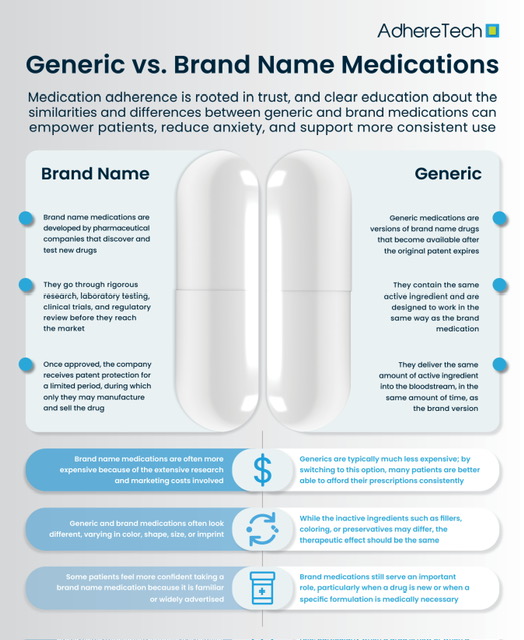
Brand name medications are developed by pharmaceutical companies that discover and test new drugs.2 These medications go through rigorous research, laboratory testing, clinical trials, and regulatory review before reaching the market.2 Once approved, the company receives patent protection for a certain period. During that time, only that company is allowed to manufacture and sell the drug.2
Because of the extensive research and marketing costs involved, brand name medications are often more expensive.3 Many patients first encounter a drug in its brand form, especially if it is relatively new or heavily advertised.
What Are Generic Medications?
Generic medications are versions of brand name drugs that become available after the original patent expires.4 They contain the same active ingredient and are designed to work in the same way as the brand medication.4 Generic drugs must meet strict regulatory standards set by health authorities.4
To gain approval, a generic medication must demonstrate bioequivalence, meaning it delivers the same amount of active ingredient into the bloodstream, in the same amount of time, as the brand version.5 While the inactive ingredients such as fillers, coloring, or preservatives may differ, the therapeutic effect should be the same.4,5
Effectiveness and Safety
One of the biggest concerns long term patients have is whether generic medications work as well as brand name drugs.6 In the vast majority of cases, the answer is yes. Regulatory agencies require generics to meet the same standards for quality, strength, purity, and stability as brand medications.4,5
For most conditions like high blood pressure, diabetes, high cholesterol, and asthma, generic medications provide the same health benefits as their brand counterparts.7 Studies involving millions of patients have shown no meaningful difference in outcomes when patients use generics instead of brands.8
However, there are a few situations where extra monitoring may be advised. Some medications have a narrow therapeutic range, meaning small changes in drug levels can have a big impact.8 Examples include certain thyroid medications, anti seizure drugs, and blood thinners.7 Even in these cases, generics are still considered effective, but consistency matters.7 Patients are often advised to stay with the same manufacturer once stable and to communicate any changes with their healthcare provider.
Differences in Appearance and Packaging
Generic and brand medications often look different, varying in color, shape, size, or imprint.8 For long term patients, especially those taking multiple medications, this can be confusing and sometimes alarming. A pill that suddenly looks different may lead to doubts about whether it is the correct medication.
This visual change alone can affect adherence, with some patients stopping taking their medication because they believe a mistake has been made.8 Pharmacists and healthcare providers must reassure patients that changes in appearance are normal when switching between manufacturers or between brand and generic versions.
Using pill organizers, medication lists, and reminder apps can also help patients stay confident and organized despite appearance changes.
Cost and Access Considerations
Cost is one of the most significant differences between brand and generic medications.3 Generics are typically much less expensive because manufacturers do not bear the cost of developing the drug from scratch.3 For long term patients, this cost difference can have a major impact on adherence.6
High out of pocket costs are a common reason people skip doses, split pills, or stop medications altogether.6 By switching to a generic option, many patients are better able to afford their prescriptions consistently.6 In fact, many insurance plans often encourage or require the use of generics by offering lower copays.
Improved affordability leads directly to better adherence, which in turn leads to better health outcomes over time.6
Emotional and Psychological Factors
Trust plays a major role in medication adherence.1 Some patients feel more confident taking a brand name medication because it is familiar or widely advertised.4 Others worry that a lower price means lower quality.4
These perceptions are understandable, especially for individuals who have relied on a specific medication for years. A sudden switch may feel unsettling, even if it is medically appropriate.
Healthcare providers can support adherence by acknowledging these concerns and providing clear explanations. Patients should feel comfortable asking questions such as why a switch is being made, whether it will affect symptom control, and what signs to watch for after a change.
When patients feel heard and informed, they are more likely to stay committed to their treatment plan.1
Switching Between Brand and Generic Medications
Many long term patients will switch between brand and generic medications at some point–this may happen when a generic becomes available, when insurance coverage changes, or when pharmacy suppliers change.6
If a switch occurs, patients should monitor how they feel and report any new or worsening symptoms to their healthcare provider. Most of the time, no issues arise, but open communication helps catch rare problems early and builds confidence in the process.
It is also helpful to keep a consistent medication routine. Taking medicine at the same time each day, linking it to daily habits, and using reminders can reduce the impact of any concerns related to switching.
Making Informed Choices for Long Term Health
For long term patients, the goal is not just taking medication today, but sustaining adherence over months and years. Understanding the similarities and differences between brand and generic medications removes unnecessary barriers and fear.
Generic medications are a safe, effective, and affordable option for most people.7 Brand medications still have an important role, particularly when a drug is new or when a specific formulation is medically necessary.2 The best choice depends on the individual patient, their condition, and their circumstances.
Patients are encouraged to take an active role in their care. Asking questions, reviewing medication lists regularly, and discussing preferences with healthcare providers all contribute to better adherence.
Medication adherence is built on trust, understanding, and practical support. For long term patients, clarity about generic versus brand medications can make the difference between consistent use and missed doses.
By recognizing that generics meet the same standards for safety and effectiveness, understanding why they look different, and appreciating the financial benefits they offer, patients can approach their treatment with greater confidence.
References
Desai, R.J., Sarpatwari, A., Dejene, S., Khan, N.F., Lii, J., Rogers, J.R., Dutcher, S.K., Raofi, S., Bohn, J., Connolly, J.G., Fischer, M.A., Kesselheim, A.S. and Gagne, J.J. (2019). Comparative effectiveness of generic and brand-name medication use: A database study of US health insurance claims. PLOS Medicine, 16(3), p.e1002763. doi:https://doi.org/10.1371/journal.pmed.1002763.
Dunne, S., Shannon, B., Dunne, C. and Cullen, W. (2013). A review of the differences and similarities between generic drugs and their originator counterparts, including economic benefits associated with usage of generic medicines, using Ireland as a case study. BMC Pharmacology and Toxicology, 14(1). doi:https://doi.org/10.1186/2050-6511-14-1.
FDA (2019). Abbreviated New Drug Application (ANDA): Generics. [online] U.S. Food and Drug Administration. Available at: https://www.fda.gov/drugs/types-applications/abbreviated-new-drug-application-anda.
McKnight, J. and Gupta, S. (2021). Generic vs brand name drugs: Effectiveness, price, and safety. [online] Business Insider. Available at: https://www.businessinsider.com/reference/generic-vs-brand-name-drugs [Accessed 23 Dec. 2025].
Patel, S., Huang, M. and Miliara, S. (2025). Understanding Treatment Adherence in Chronic Diseases: Challenges, Consequences, and Strategies for Improvement. Journal of Clinical Medicine, [online] 14(17), pp.6034–6034. doi:https://doi.org/10.3390/jcm14176034.
Reisman, M. (2014). The Same but Not the Same. Pharmacy and Therapeutics, [online] 39(11), p.793. Available at: https://pmc.ncbi.nlm.nih.gov/articles/PMC4218676/.
Straka, R.J., Keohane, D.J. and Liu, L.Z. (2017). Potential Clinical and Economic Impact of Switching Branded Medications to Generics. American Journal of Therapeutics, 24(3), pp.e278–e289. doi:https://doi.org/10.1097/mjt.0000000000000282.
Torjesen, I. (2015). Drug development: the journey of a medicine from lab to shelf. [online] The Pharmaceutical Journal. Available at: https://pharmaceutical-journal.com/article/feature/drug-development-the-journey-of-a-medicine-from-lab-to-shelf.
Torreele, E. (2024). Why are our medicines so expensive? Spoiler: Not for the reasons you are being told…. European Journal of General Practice, [online] 30(1). doi:https://doi.org/10.1080/13814788.2024.2308006.