
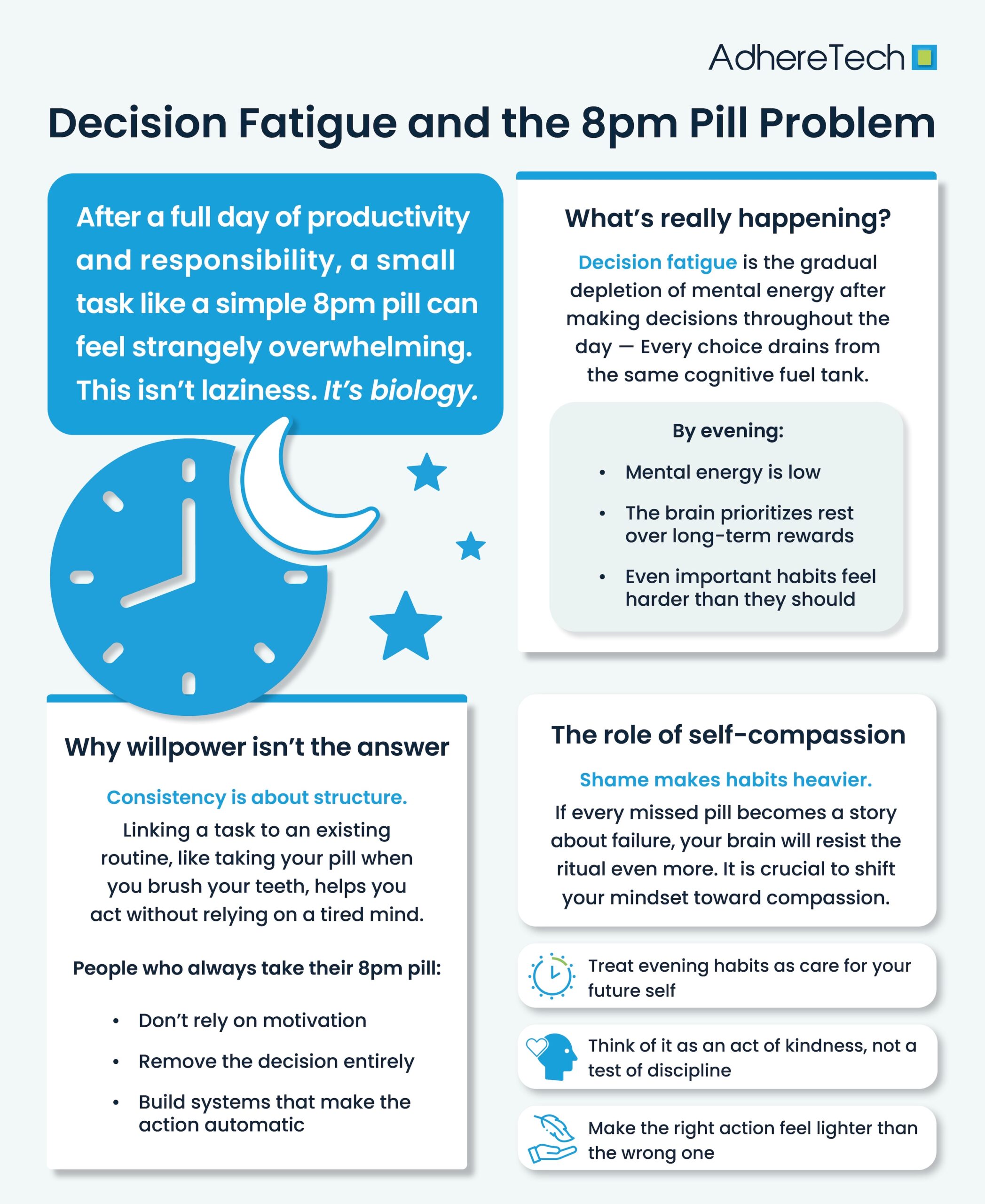
What Is the 8pm Pill Problem?
At 8pm, the day should be winding down. The kitchen is quieter, the inbox is closed, and the couch is calling. And yet, for many people, 8pm is the moment everything falls apart.
The alarm goes off. A small white pill waits on the counter. You know it matters. You know you should take it. And somehow, despite a day full of competence, responsibility, and follow through, this one tiny action feels strangely difficult.
This is the 8pm pill problem, and it has very little to do with pills.1
It is about why tasks that seem trivial on paper can feel insurmountable at the end of the day, especially when they matter to us.1
Understanding Decision Fatigue
Decision fatigue is the slow erosion of our ability to make good choices after a long day of making them.2 Every decision, even the small ones, draws from the same mental fuel. What to wear. How to respond to a message. Whether to speak up or stay quiet. By evening, that fuel tank is low.
When something important but unglamorous shows up late in the day, it often gets shortchanged.
The cruel irony is that the things we schedule for later are often the things we care about most. Medication. Stretching. Journaling. Learning a language. Calling a parent. These are not urgent in the way emails are urgent. No one is waiting on the other side demanding immediate action. So when decision fatigue sets in, these commitments quietly become optional in our tired brains.
Why Important Habits Fail at Night
The 8pm pill problem exists because it asks too much at exactly the wrong time. It asks for remembering, for prioritizing, and for self-trustself trust, all after a full day of cognitive labor.2 By then, your mind is no longer oriented toward long term benefits.1 It is negotiating for rest.
The pill becomes a symbol of one more thing, and one more thing feels unbearable.
Most advice treats this as a motivation issue. Try harder. Be more disciplined. Care more about your health. None of this works for long, because the issue is not a lack of care.1 It is a lack of capacity. Decision fatigue is not a moral failing. It is a predictable biological response.
The Science Behind Decision Fatigue
Research on decision fatigue shows that as people make more decisions, their choices become more impulsive or more avoidant.2 Judges grant parole less often late in the day.² Shoppers make more indulgent purchases at night.4 Even choosing nothing counts as a decision, and avoidance is often the path of least resistance.4
Not taking the pill is easier than taking it, not because it is better, but because it requires less effort in the moment.
This is why evening willpower feels unreliable. The brain defaults to whatever costs the least energy right now, not what produces the best outcome later.
Why Willpower Is Not the Solution
The mistake many people make is assuming that consistency comes from strength. In reality, consistency comes from structure.5 The people who never forget their 8pm pill are not more virtuous. They have simply removed the decision from the equation.
The pill is next to the toothbrush. The alarm is paired with an automatic action. The environment does the remembering so the brain does not have to.
This is why habits work best when they are boring and obvious. When you tie an action to an existing routine, you bypass the part of the mind that is already exhausted.5 You are no longer deciding whether to take the pill. You are following a familiar script: brush teeth, wash face, take pill.
The Emotional Weight of Evening Routines
Another overlooked part of the problem is emotional.1 Evening is often when feelings catch up. The day slows down, and whatever you have been holding at bay comes forward. Anxiety. Sadness. Resentment. Or just a vague sense of depletion.
In that state, even neutral tasks can feel heavy.2
The pill can start to represent the condition it treats, or the vulnerability it implies. Skipping it can become a quiet act of avoidance, not of the pill itself, but of what it reminds you of.
Self Compassion and Habit Formation
Compassion matters here. Shaming yourself for forgetting only adds another layer of emotional weight to an already fragile moment. If every missed pill comes with a story about failure, the brain will resist the entire ritual even more strongly.
The goal is not to scare yourself into compliance. The goal is to make the right action feel lighter than the wrong one.
One useful reframing is to treat evening commitments as favors to your future self, not obligations imposed by your past self. At 8pm, you are not proving anything. You are offering care. This shift changes the emotional tone of the task, and care feels different from duty when energy is low.
Rethinking Timing and Environment
It is also worth questioning why 8pm was chosen in the first place. Many schedules are inherited from instructions, not designed around real lives.2 If a pill can be taken at dinner, or in the morning, or with a daily anchor that already exists, that change can be transformative.6
Optimal timing on paper is meaningless if it consistently fails in practice.
The broader lesson of the 8pm pill problem is that willpower is a terrible long term strategy. Systems beat intentions every time. When something matters, it should not depend on how strong or focused or motivated you feel at the end of the day.³ It should be woven into the fabric of your environment and routines.6
Final Thoughts
Decision fatigue is not going away. Modern life all but guarantees it. The solution is not to expect more from depleted minds, but to ask less of them. Fewer decisions, clearer cues, and kinder self talk.
When those are in place, the small white pill stops being a nightly battle and becomes just another quiet part of taking care of yourself.
And when 8pm rolls around, you might find that the hardest part of the day no longer asks you to decide at all.
References
- Badawy, Sherif M, et al. “Habit Strength, Medication Adherence, and Habit-Based Mobile Health Interventions across Chronic Medical Conditions: Systematic Review.” Journal of Medical Internet Research, vol. 22, no. 4, 28 Apr. 2020, p. e17883, https://doi.org/10.2196/17883.
- “Bedtime Browsing Trend Fuels Night-Time Shopping at John Lewis.” The Guardian, 9 Sept. 2019, www.theguardian.com/business/2019/sep/09/bedtime-browsing-trend-fuels-boom-night-time-shopping-at-john-lewis.
- McFadden, Robert. “Willpower vs. Habits.” Medium, 28 Dec. 2025, medium.com/@endself-sabotage/willpower-vs-habits-ae8aa110e052. Accessed 2 Feb. 2026.
- Pignatiello, Grant A, et al. “Decision Fatigue: A Conceptual Analysis.” Journal of Health Psychology, vol. 25, no. 1, 23 Mar. 2018, www.ncbi.nlm.nih.gov/pmc/articles/PMC6119549/, https://doi.org/10.1177/1359105318763510.
- Tierney, John. “Do You Suffer from Decision Fatigue?” The New York Times, 17 Aug. 2011, www.nytimes.com/2011/08/21/magazine/do-you-suffer-from-decision-fatigue.html
- “What Doctors Wish Patients Knew about Decision Fatigue.” American Medical Association, 21 Mar. 2025, www.ama-assn.org/public-health/behavioral-health/what-doctors-wish-patients-knew-about-decision-fatigue.