
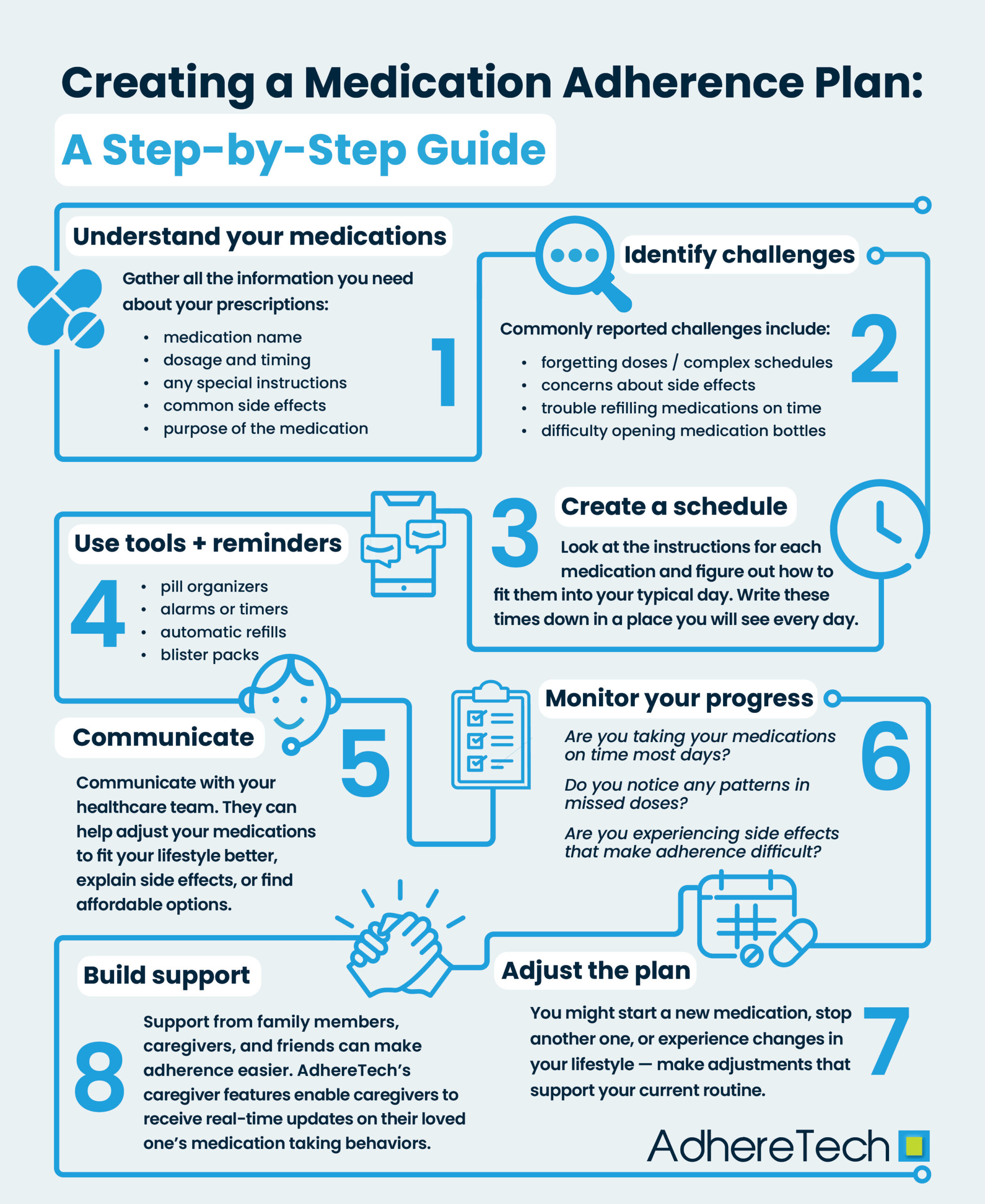
Staying on track with medications is one of the most important parts of effectively managing your health.1 Whether you are required to take your medication anywhere from sporadically to multiple times each each day, keeping up with the schedule can be challenging. Missed doses or incorrect timing can reduce how well your treatment works and may even lead to additional health risks.2 The good news is that a well designed medication adherence plan, that supports your health goals and fits your daily routine, can make taking your medication easier and more consistent.
Why Medication Adherence Matters
Before building a plan, it is helpful to understand why adherence is so important. Medications work best when they are taken exactly as prescribed.3 This means taking the right dose, at the right time, and in the right way.3 Good adherence helps prevent symptoms from returning or getting worse, reducing the risk of complications, supporting long term health, and helping you get the full benefit of your treatment.4
However, non adherence can happen for many reasons. You may forget doses, feel overwhelmed by multiple prescriptions, worry about side effects, or struggle with costs associated with accessing your medication(s).5 While many feel embarrassed to admit their challenges with adherence to their providers, these are common challenges and they are nothing to feel ashamed about. Being honest with your provider can help you work together to create a proactive plan that can address these issues and help you stay organized and confident.
Step 1: Understand Your Medications
Start by gathering all the information you need about your prescriptions. This includes:
- The name of each medication
- The dose and how often you need to take it
- Special instructions (such as take with food or avoid certain activities)
- Consult with a doctor regarding potential drug-drug interactions before starting medication.
- Common side effects and what to do if you experience them
- The purpose of each medication and how it supports your health.
You can find this information on your prescription label, the packet insert, or through a conversation with your healthcare provider. Understanding what you take and why you take it will help increase your confidence and help you recognize the importance of consistency.
Do not be afraid to ask your healthcare provider questions regarding your medication, dosing schedule, potential side effects, or anything else you may be confused or concerned about in relation to your medication.
Step 2: Identify Your Challenges
Next, think about the barriers that may make adhering to your prescription(s) difficult. Commonly reported challenges include forgetting doses, complex schedules (such as taking multiple medications throughout the day), difficulty opening medication bottles, concerns about side effects, or trouble refilling medications on time.6
Take a moment to write down the obstacles you face and share these with your providers. Being honest and specific will help you and your provider partner together to create practical solutions. For example, if your mornings are rushed, you may need a way to remind yourself to take your medication before you leave home. If you take multiple medications, you might need a more sophisticated system to simplify your regimen and help you avoid confusion. Proactively identifying challenges is a key part of building an effective plan that can help to prevent medication nonadherence issues arising within the future.
Step 3: Create a Consistent Medication Schedule
A clear and realistic schedule is at the heart of a good adherence plan. Look at the instructions for each medication and figure out how to fit them into your typical day. Aim for times that are easy for you to remember and consistent with your lifestyle.
For instance, try to pair your doses with your existing daily habits, like brushing your teeth or eating meals. Consistency helps reinforce the routine so your medication becomes part of your natural rhythm. If you take multiple prescriptions, try to create a plan that allows you to simplify the timing when possible, but always confirm changes with your healthcare provider.
Once you decide on the ideal dosing times for your medications, write them down in a place you will see every day. A printed chart, a notebook, or a digital calendar can all work well. The goal is to make your schedule clear and easy to follow. Sharing this schedule with your healthcare providers can enable them to make recommendations, such as digital adherence tools, that can further simplify your medication regimen, allowing it to seamlessly fit into your existing schedule.
Step 4: Use Tools and Reminders
Many people benefit from tools that make adherence easier. Some common recommendations include:
- Pill organizers such as weekly or monthly boxes that separate doses
- Alarms or timers that help you stay on schedule
- Automatic prescription refills at your pharmacy
- Blister packs provided by some pharmacies to organize daily doses
It is important to choose the tools that align with your lifestyle and needs. If you prefer simple approaches, a pill box and a written chart may be enough. If you struggle with remembering to take your medication or anticipate challenges, consider asking your providers about digital adherence tools that provide automated reminders, reducing the mental load associated with remembering to take your medication. Devices such as AdhereTech’s Aidia System offer customizable, real-time reminders that seamlessly integrate medication taking into a patient’s daily routine, enhancing the habit formation process.
With additional capabilities to determine adherence behaviors in real-time and when patients are running low on their medication, these devices can help to overcome many of the commonly reported challenges to successful medication adherence.
Step 5: Communicate with Your Healthcare Team
Your healthcare providers are valuable partners in your adherence plan. Talk to them about any challenges you have identified. They can help adjust your medications to fit your lifestyle better, explain side effects, or find affordable options.
If cost is a concern, ask about generic versions, assistance programs, or alternative medications that may be more affordable. For example, AdhereTech’s care team helps to connect patients with financial resources to prevent lapses in taking their medication. If you find the schedule too complicated, your provider may be able to simplify it. Your provider may recommend switching to a once daily dosing regimen or suggest digital devices that remove the cognitive burden associated with remembering to take medication numerous times throughout the day. Openly communicating with your provider(s) can prevent small issues from becoming major obstacles.
Step 6: Monitor Your Progress
Once your plan is in place, check in with yourself regularly. Are you taking your medications on time most days? Do you notice any patterns in missed doses? Are you experiencing side effects that make adherence difficult?
Keeping a simple log can be helpful. You can also review your progress during medical appointments. Tracking your habits helps you understand what is working and what may need adjustment.
Notably, self-reported medication adherence logs are vulnerable to both inadvertent inaccuracies—such as forgetting to record doses in real time and documenting them later when recall may be impaired—and intentional misreporting, including overstating adherence due to fear of negative consequences associated with admitting nonadherence.7 Utilizing real-time monitoring devices that passively track your adherence behaviors, and provide you the opportunity to automatically report reasons for non adherence via SMS messaging, may help to reduce such biases, providing a clearer, more accurate picture of your adherence.8
If you do miss a dose, do not get discouraged, forgetfulness is part of human nature. Simply follow the instructions provided by your healthcare provider for missed doses and continue with your schedule. If possible, identify reasons for non adherence and develop a plan to prevent such issues from arising in the future. The goal is steady progress, not perfection.
Step 7: Adjust the Plan When Needed
Your medication needs may change over time, and your adherence plan should evolve along with them. You might start a new medication, stop another one, or experience changes in your lifestyle that require an updated schedule.
Review your plan whenever something changes and make adjustments that support your current routine. Staying flexible helps you maintain long term success.
Step 8: Build Support Into Your Routine
Support from family members, caregivers, or friends can make adherence easier. Share your schedule with someone you trust, or ask for help organizing or remembering doses when needed. AdhereTech’s caregiver features enables caregivers to receive real-time updates on their loved one’s medication taking behaviors, providing an additional layer of support to ensure you are taking your medication as prescribed.
Final Thoughts
Creating a medication adherence plan is an empowering step toward better health. By understanding your medications, identifying challenges, building a clear schedule, and using helpful tools, you can take control of your treatment with confidence. Remember that adherence is a journey. With patience, organization, and support, you can make your medication routine smoother and more effective.
If you ever feel overwhelmed or unsure, reach out to your healthcare provider. You are not alone. With the right plan, you can stay on track and give yourself the best possible chance for positive health outcomes.
References
- Brown, Marie T., and Jennifer K. Bussell. “Medication Adherence: WHO Cares?” Mayo Clinic Proceedings, vol. 86, no. 4, Apr. 2011, pp. 304–314, https://doi.org/10.4065/mcp.2010.0575.
- Jimmy, Benna, and Jimmy Jose. “Patient Medication Adherence: Measures in Daily Practice.” Oman Medical Journal, vol. 26, no. 3, May 2021, pp. 155–159, www.ncbi.nlm.nih.gov/pmc/articles/PMC3191684/, https://doi.org/10.5001/omj.2011.38.
- Johns Hopkins Medicine. “Help for Managing Multiple Medications.” Www.hopkinsmedicine.org, 2024, www.hopkinsmedicine.org/health/wellness-and-prevention/help-for-managing-multiple-medications.
- Olsson, Regan. “The Importance of Taking Medications as Prescribed | Banner.” Www.bannerhealth.com, 4 Mar. 2021, www.bannerhealth.com/healthcareblog/teach-me/the-importance-of-taking-your-medication-as-prescribed.
- Religioni, Urszula , et al. “Enhancing Therapy Adherence: Impact on Clinical Outcomes, Healthcare Costs, and Patient Quality of Life.” Medicina, vol. 61, no. 1, 17 Jan. 2025, pp. 153–153, pmc.ncbi.nlm.nih.gov/articles/PMC11766829/, https://doi.org/10.3390/medicina61010153.
- Tariq, Rayhan, et al. “Medication Dispensing Errors and Prevention.” National Library of Medicine, StatPearls Publishing, 2024, www.ncbi.nlm.nih.gov/books/NBK519065/
- Ho, P. Michael, et al. “Medication Adherence.” Circulation, vol. 119, no. 23, 16 June 2009, pp. 3028–3035, www.ahajournals.org/doi/full/10.1161/circulationaha.108.768986, https://doi.org/10.1161/circulationaha.108.768986.
- Ershad Sarabi, Roghayeh, et al. “The Effectiveness of Mobile Phone Text Messaging in Improving Medication Adherence for Patients with Chronic Diseases: A Systematic Review.” Iranian Red Crescent Medical Journal, vol. 18, no. 5, 30 Apr. 2016, www.ncbi.nlm.nih.gov/pmc/articles/PMC4939231/, https://doi.org/10.5812/ircmj.25183.